
Autonomous Agent Transitions in AgenticOS
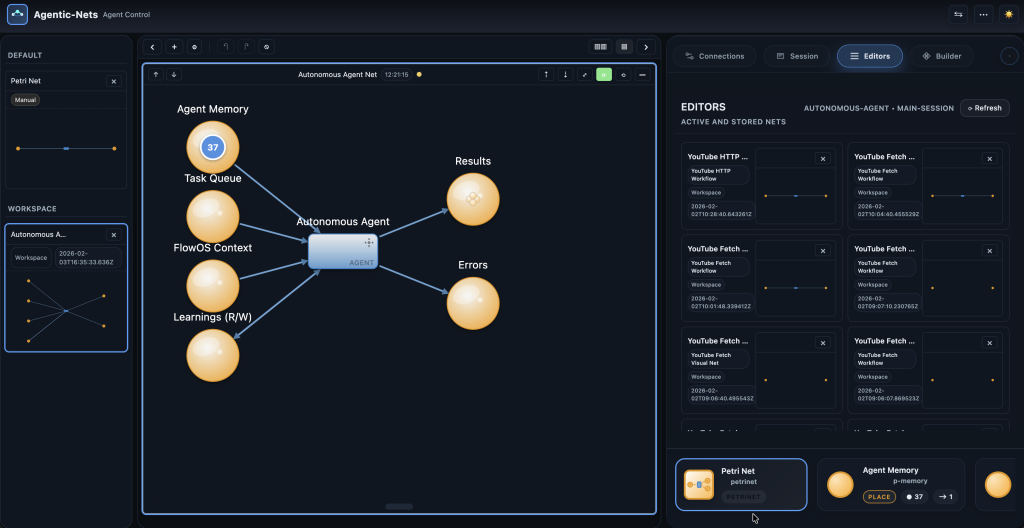
AgenticOS introduces a revolutionary capability: Agent Transitions – transitions powered by LLMs that can reason, query, create structures, and even deploy new transitions autonomously. This guide explores the full spectrum of agent capabilities, from simple token processing to self-improving meta-agents.
The Role Hierarchy
Agent transitions operate under a role-based access control system. Each role grants access to more powerful capabilities, building on the previous level.
Basic Agent Inscription
At its simplest, an agent transition reads natural language instructions from a token and executes them using available tools.
{
  "id": "t-processor",
  "kind": "agent",
  "presets": {
    "task": {
      "placeId": "p-tasks",
      "host": "user-leo@localhost:8080",
      "arcql": "FROM $ LIMIT 1",
      "take": "FIRST",
      "consume": true
    }
  },
  "postsets": {
    "result": {
      "placeId": "p-results",
      "host": "user-leo@localhost:8080"
    }
  },
  "action": {
    "type": "agent",
    "role": "TOKEN_RW",
    "nl": "@task.data.instruction"
  },
  "emit": [
    { "to": "result", "from": "@response", "when": "success" }
  ],
  "mode": "SINGLE"
}
The nl field uses expression syntax to read the instruction from the bound token’s data. The agent will execute tools iteratively until it calls DONE or FAIL.
The Agent Execution Loop
Unlike other transitions that fire once, agent transitions run an iterative conversation loop with the LLM until completion.
META_AGENT: Discovery + Creation
The META_AGENT role adds model-wide visibility – the agent can discover sessions, nets, and transitions across the entire model. But there’s a twist: access is controlled by a memory place.
Permission by Memory
The agent can only access resources mentioned in its memory tokens. This creates a secure, self-documenting permission system.
Summary
- Agent transitions are LLM-powered, running an iterative tool-calling loop
- 5 roles from READ_ONLY (7 tools) to META_AGENT_AUTONOMOUS (22 tools)
- Permission by memory – agents only access resources in their memory tokens
- Auto-emit – creating resources automatically adds memory tokens
- Flexible context – session/model can come from inscription, metadata, or tokens
- Self-improving systems – META_AGENT_AUTONOMOUS can create, deploy, and start new transitions
Agent transitions represent the pinnacle of AgenticOS automation – intelligent, self-improving agentic processes that can reason about and extend themselves.