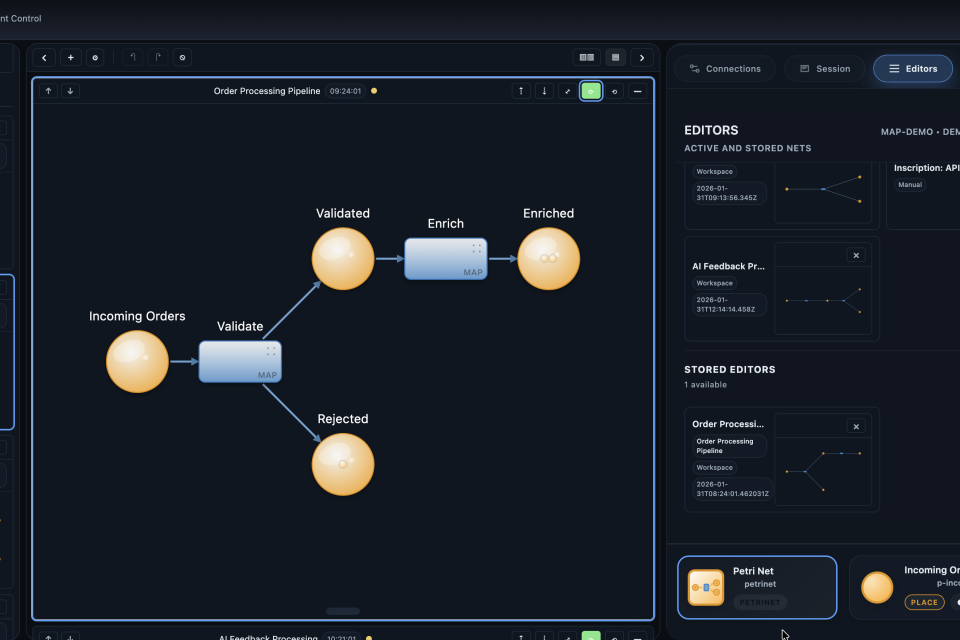
AgenticOS Building Blocks: Map Transitions – Data Transformation

While Pass transitions route tokens unchanged, Map transitions transform token data through templates. They’re the workhorses of data reshaping – adding fields, removing fields, restructuring, enriching, and preparing data for downstream processing. Map transitions take input token data, apply a template transformation, and emit the … … Continue readingAgenticOS Building Blocks: Map Transitions – Data Transformation

Autonomous Agent Transitions in AgenticOS: From Simple Automation to Self-Improving Systems

AgenticOS introduces a revolutionary capability: Agent Transitions – transitions powered by LLMs that can reason, query, create structures, and even deploy new transitions autonomously. This guide explores the full spectrum of agent capabilities, from simple token processing to self-improving meta-agents. Agent transitions operate under a … … Continue readingAutonomous Agent Transitions in AgenticOS: From Simple Automation to Self-Improving Systems

AgenticOS: Pass vs Map Transitions – Quick Reference

Pass and Map are the two foundational transition types in AgetnticOS. Understanding their differences is crucial for building effective agentic processes. This guide compares them side-by-side to help you choose the right one. This is the most critical difference: what the when condition evaluates. A … … Continue readingAgenticOS: Pass vs Map Transitions – Quick Reference

AgenticOS Building Blocks: The Six Transition Types – Complete Overview

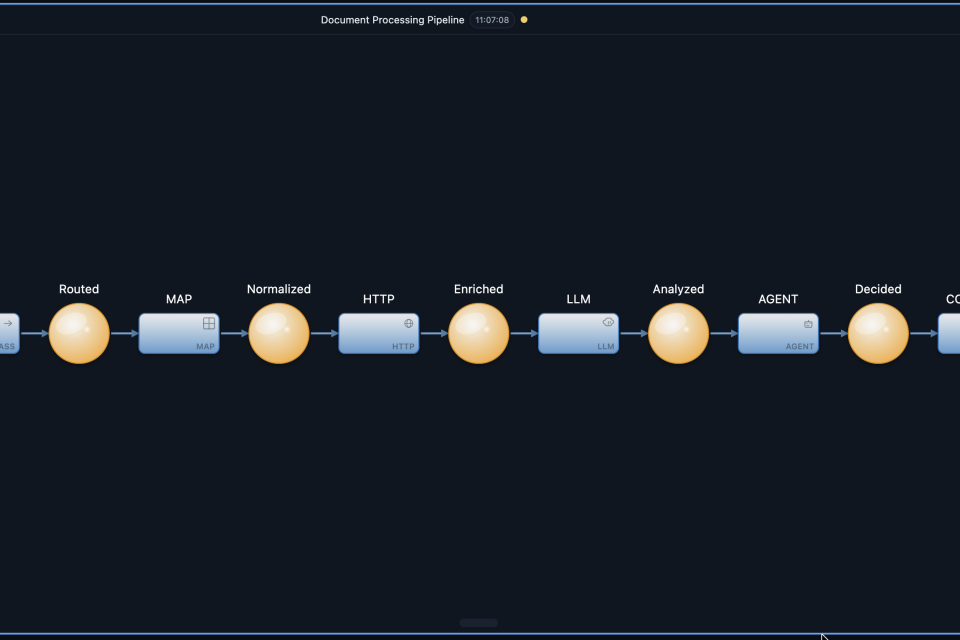
AgetnticOS provides six distinct transition types, each designed for specific agentic patterns. Understanding when to use each type is fundamental to building effective agentic processes. Purpose: Route tokens without transforming them – pure decision logic. Purpose: Transform token data through templates – reshape, enrich, restructure. … Continue readingAgenticOS Building Blocks: The Six Transition Types – Complete Overview

Agentic Nets Building Blocks – Document Processing

Agentic Nets are executable Petri nets that combine traditional process modeling with intelligent automation. They transform static process diagrams into living systems that can route, transform, integrate, analyze, decide, and execute – all orchestrated through six fundamental building blocks. Each building block is a transition … … Continue readingAgentic Nets Building Blocks – Document Processing

Command Transitions

The Command transition enables Petri nets to execute shell commands, scripts, and file system operations through the agentic-net-executor service. While LLM transitions process AI prompts and Agent transitions enable autonomous reasoning, Command transitions provide direct system execution – running bash commands, scripts, and file operations … … Continue readingCommand Transitions