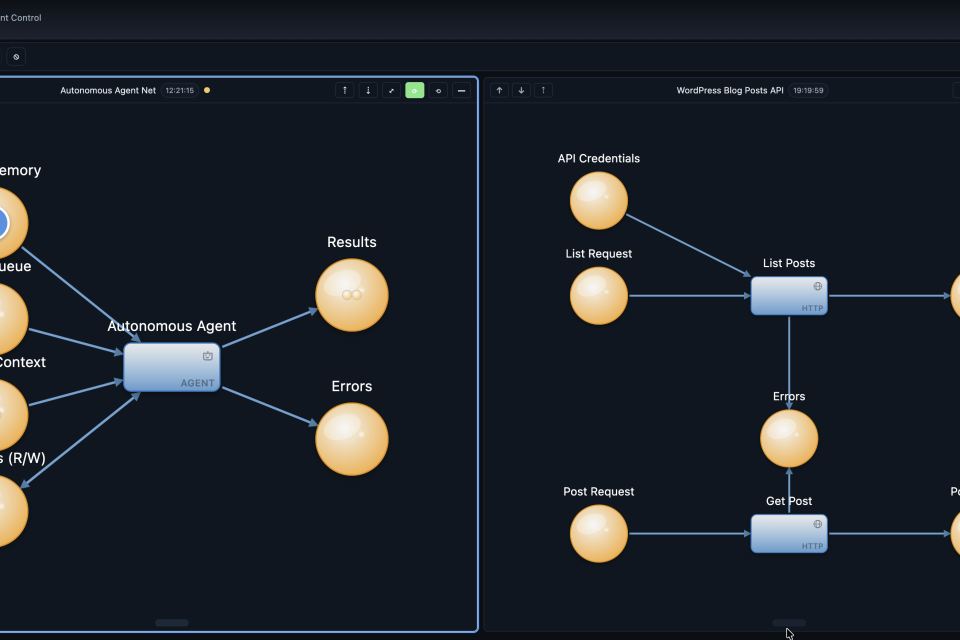
Autonomous Agents That Build Their Own Infrastructure

What if AI agents didn’t just execute tasks—but designed and constructed the systems they need to complete them? And what if every capability they have—calling APIs, running shell commands, installing software on remote machines—was channeled through secure, auditable pathways that you configure? AgenticOS makes both … … Continue readingAutonomous Agents That Build Their Own Infrastructure

AgenticOS Building Blocks: Agent Transitions – Autonomous AI Execution

Agent transitions represent the most powerful building block in AgetnticOS. Unlike LLM transitions that process prompts and return responses, Agent transitions execute autonomous AI agents that can make decisions, call tools, and produce entirely new data structures. Key Innovation: Agent transitions have optional presets (agents … … Continue readingAgenticOS Building Blocks: Agent Transitions – Autonomous AI Execution

AgenticOS Building Blocks: LLM Transitions – AI-Powered Token Processing

LLM (Large Language Model) transitions bring the power of AI directly into your agentic processes. They enable natural language processing, text generation, sentiment analysis, entity extraction, and intelligent routing – all orchestrated through simple inscriptions. Key Innovation: LLM transitions use a two-field emit pattern where … … Continue readingAgenticOS Building Blocks: LLM Transitions – AI-Powered Token Processing

AgenticOS Building Blocks: Command Transitions – Shell & Filesystem Execution

Command transitions execute shell commands and filesystem operations via the agentic-net-executor service. They enable your Petri nets to interact with the operating system – running scripts, managing files, invoking CLI tools, and integrating with external processes. Command transitions dispatch work to the executor service and … … Continue readingAgenticOS Building Blocks: Command Transitions – Shell & Filesystem Execution

AgenticOS: Template Interpolation – Accessing Token Data in Inscriptions

Template interpolation is how AgetnticOS transitions access and transform token data. Using ${…} syntax, you can reference input token fields, metadata, and build dynamic outputs in Map templates, HTTP bodies, LLM prompts, and more. Templates use hierarchical paths to access token data and metadata: Understanding … … Continue readingAgenticOS: Template Interpolation – Accessing Token Data in Inscriptions

AgenticOS Building Blocks: HTTP Transitions – External API Integration

HTTP transitions connect your agentic processes to the outside world. They make REST API calls, process responses, handle authentication, implement retry logic, and route results based on HTTP status codes or response content. HTTP transitions call external APIs and emit parsed response data to success … … Continue readingAgenticOS Building Blocks: HTTP Transitions – External API Integration

AgenticOS: ArcQL Query Language – Token Selection Syntax

ArcQL (Arc Query Language) is AgetnticOS’s query language for selecting tokens from places. Every transition preset uses ArcQL to specify which tokens to consume, making it fundamental to understanding how tokens agentic through your Petri nets. Key Rule: All paths must start with $ (the … … Continue readingAgenticOS: ArcQL Query Language – Token Selection Syntax

AgenticOS Building Blocks: Pass Transitions – Pure Token Routing

The Pass transition is the foundational routing primitive in AgetnticOS Petri nets. It examines token data and decides where each token should go – without transforming it, without calling external systems, without side effects. Think of it as a railway switch operator: tokens arrive, get … … Continue readingAgenticOS Building Blocks: Pass Transitions – Pure Token Routing

AgenticOS Building Blocks: Map Transitions – Data Transformation

While Pass transitions route tokens unchanged, Map transitions transform token data through templates. They’re the workhorses of data reshaping – adding fields, removing fields, restructuring, enriching, and preparing data for downstream processing. Map transitions take input token data, apply a template transformation, and emit the … … Continue readingAgenticOS Building Blocks: Map Transitions – Data Transformation

From Agent Chaos to Intelligent Control: The Missing Layer for Enterprise AI

Every enterprise deploying AI agents eventually hits the same wall. It’s not about the agents themselves—they’re capable enough. The wall is what happens when you have fifty of them running across your organization with no unified way to see whatContinue readingFrom Agent Chaos to Intelligent Control: The Missing Layer for Enterprise AI